
Deadcode Slot Review 2026: ELK Studios’ Cyberpunk System
Released on 5 May 2026, Deadcode is a cyberpunk slot from ELK Studios built around connected-symbol wins, cascading reactions and five feature meters. The story imagines a near future in which five mega-corporations control digital life by harvesting personal data and using automated identities to influence human behaviour. A hacker collective known as Null fights back, and the grid is presented as the interface for that conflict. Beneath the neon setting is a demanding high-volatility game with a 5×5 starting layout, an expanding grid, a Global Multiplier, Bonus and Super Bonus rounds, and a maximum win capped at 5,000 times the stake. This review explains how each part works, where the strongest win potential sits and which details players should verify before using real money.
Deadcode Overview, Theme and Core Game Format
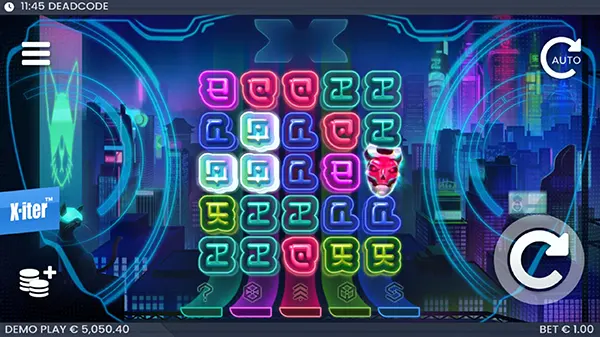
Deadcode begins on five columns and five rows rather than a conventional set of reels with fixed paylines. Wins form when at least three identical payout symbols connect horizontally or vertically. Diagonal contact alone does not qualify, so the shape of each cluster matters. Winning symbols disappear, the remaining icons move down and fresh ones enter the empty spaces. This cascading process continues while new qualifying combinations are created. It gives a single paid spin several opportunities to develop, but most sequences are brief unless a feature reshapes the grid or creates a useful Wild. The format is easy to follow after several rounds because the game highlights the connected symbols and shows the current multiplier beside the grid.
The initial 5×5 layout can grow to five columns by seven rows through the Refresh Subroutine. Two additional rows do not guarantee a stronger return, yet they place more symbols on screen and create more possible points of contact. This matters because Deadcode is designed around extended chains rather than one isolated payout. The standard symbol set uses brightly coloured digital glyphs, with higher-value signs paying more for larger groups. Wilds substitute for regular payout symbols, while Bonus and Super Bonus symbols control entry to the two main feature rounds. A winning group of exactly three symbols also creates a Wild in its central position, providing a small but potentially important bridge for the next cascade.
The published maximum is 5,000× the selected stake. That is a meaningful ceiling, although it is lower than the five-figure limits used by several other high-volatility releases in 2026. Deadcode compensates with a layered structure in which collectors, symbol changes, grid expansion and a rising multiplier can interact during the same sequence. The important point is that the headline maximum is a rare mathematical limit, not an expected target. A player staking £1 would have a theoretical maximum return of £5,000 before any operator-specific limits, but ordinary sessions will usually produce results far below that amount. Stake size should therefore be selected according to an affordable session budget rather than the size of the advertised prize.
Visual Design, Sound and Mobile Presentation
ELK Studios gives Deadcode a coherent dystopian identity rather than attaching a few neon details to an unrelated slot layout. The main screen looks across a dense city of illuminated towers, corrupted advertising and cold electronic interfaces. The grid resembles a live intrusion tool, with five coloured channels running into the columns from below. These channels are not merely decorative because they represent the five Collector meters. Symbols break apart like damaged data when removed, while feature activations resemble commands being executed against the corporate network. The visual language helps explain the mechanics: colours, column positions and feature icons remain consistent, so players can usually understand why a meter has advanced or why the grid has changed.
The soundtrack uses a steady electronic pulse with sharper effects for cascades, multiplier increases and Subroutine activations. It supports the tension without making every ordinary spin sound like a major event. That restraint is useful in a game where several modifiers may run in quick succession. The bonus section becomes darker and more intense, reinforcing the idea that Null has moved deeper into the controlled network. Although the theme includes references to data theft, bots and artificial identities, the narrative stays in the background once play begins. It provides context for the symbols and effects but does not interrupt the round with lengthy scenes or explanations.
Deadcode is designed for modern desktop, tablet and smartphone screens. On a smaller display, the grid remains readable, although the five Collector meters and the Global Multiplier naturally occupy more of the available space. Portrait play is convenient for short sessions, while landscape orientation gives a clearer view of the expanded 5×7 grid and the feature labels. ELK Studios recommends a 16:9 ratio for desktop presentation, which suits the wide city scene. No separate application is required when the game is offered through a compatible casino site. Performance will still depend on the browser, device, connection quality and the operator’s own game lobby, so a demo round is a practical way to check responsiveness before placing a stake.
Cluster Wins, Collectors and Subroutine Features
The central idea is not simply to land clusters but to use those clusters to charge five Collectors. One Collector is assigned to each column and linked to a specific Subroutine. When a winning group contains the corresponding symbol type, progress is added to the relevant meter. Wilds and special Kicker symbols can contribute to any Collector, making them more valuable than ordinary substitutes. The required charge increases through a sequence: the early activation can be reached quickly, while later charges demand more collected symbols. This prevents every small cluster from triggering a full chain of modifiers, yet it allows a productive cascade to build momentum as several meters approach completion at the same time.
When a Collector fills, its linked Subroutine changes the state of the grid. Mystery X converts positions in an X-shaped pattern into one matching symbol, which can connect areas that were previously separated. Terminate removes between one and three regular symbol types and also raises the Global Multiplier, reducing the variety left on the board. Upgrade selects a regular symbol and changes all matching instances into a higher-paying type. These effects do not guarantee a win because the final arrangement still depends on the generated symbols, but they can improve the conditions for a larger connected group or another cascade.
Refactor changes several non-winning regular positions into Wilds, Bonus symbols or Super Bonus symbols. Its value depends heavily on placement: a Wild beside two matching icons may complete a cluster, while a Bonus symbol can contribute to a feature trigger. Refresh removes the regular symbols and increases the grid by one row until the seven-row limit is reached. Once the maximum height is active, Refresh can still replace the regular icons and create another chance for connections. The five Subroutines are therefore not equal in every situation. Upgrade may be more useful on a board already holding many copies of one symbol, while Terminate or Refresh can be stronger when the grid is crowded with disconnected types.
Global Multiplier, Breach and Grid Expansion
The Global Multiplier begins at 1× and rises by one after every winning cascade in the current sequence. All wins are multiplied by the active value, so timing is important. A large cluster at the start may pay at a low multiplier, while a smaller combination later in the chain can become more valuable after several increases. In the base game, the multiplier normally resets when the round finishes. Its greater significance appears during Bonus Drops, where it remains active from one drop to the next. This persistent growth is one reason the feature rounds account for much of the game’s strongest potential, particularly when Subroutines repeatedly create new wins.
The Breach is a random intervention that can occur when a round appears to have ended. It replaces non-winning payout symbols with new ones while preserving the useful parts of the board, then checks the result again. In practical terms, it gives a stalled layout another opportunity to produce a cluster without requiring a separate paid spin. The feature is especially helpful when Wilds, Bonus symbols or a promising group are already present but surrounded by unsuitable icons. It should not be treated as a predictable safety net, because its activation is random and many rounds end without it. When it does appear, however, it can restart the cascade and keep the Global Multiplier moving.
Grid expansion is most effective when it occurs early enough for the extra rows to influence several later cascades. A 5×7 board contains forty per cent more positions than the opening 5×5 grid, but more symbols also mean more possible types competing for space. Deadcode addresses that tension through Terminate, Upgrade, Refactor and Mystery X, which can simplify or reorganise the layout after expansion. The game’s strongest sequences often come from this interaction rather than from one feature acting alone. A larger grid may provide room for more connections; Terminate may remove obstructive types; Refactor may add Wilds; and the multiplier may already be elevated by earlier wins. None of these steps changes the random nature of the result, but together they explain the game’s uneven, high-risk rhythm.
Bonus Game, Super Bonus and X-iter Options
Three Bonus symbols visible at the end of a base-game sequence trigger the standard Bonus Game with seven Bonus Drops. Each drop operates like a complete round, but three important elements persist between drops: the current grid height, the Global Multiplier and progress on all five Collector meters. This carry-over gives the feature a sense of development that the base game cannot maintain between paid spins. A slow opening drop is not necessarily wasted if it expands the grid or nearly fills several meters. Bonus symbols collected during the feature add one extra drop and then change into Wilds, so a retrigger can both extend the round and improve the current layout.
The Super Bonus begins when at least one of the three triggering symbols is a Super Bonus symbol. It also starts with seven drops and keeps the same persistent grid, multiplier and Collector progress. The major difference is that every drop guarantees between one and five Subroutine activations. This sharply increases the chance of symbol removal, upgrades, Wild creation and grid changes, although it still does not guarantee a large payout. The value of the round depends on how the features combine and whether the resulting cascades raise the Global Multiplier before the drops run out. Additional Super Bonus symbols can award another drop and become Wilds under the same general retrigger rule.
Where local rules allow it, Deadcode includes five X-iter options. Bonus Hunt costs 2.5× the normal stake and gives more than four times the usual chance of triggering the Bonus Game on that round. Mega Bonus Hunt costs 5× and increases that chance by more than eight times. Subroutine Overload costs 10×, guarantees between one and five Subroutines and upgrades a naturally triggered bonus to the Super Bonus. Direct entry to the regular Bonus costs 100×, while direct Super Bonus access costs 250×. These options increase immediate exposure and can consume a session budget quickly. They are restricted or disabled in some regulated markets, and buying a feature does not improve the maximum win or remove the house advantage.
RTP, Volatility, Maximum Win and Player Suitability
Recent listings most commonly show a top RTP setting of 96%, a hit frequency of about 25.1% and high volatility, but Deadcode may be supplied with alternative mathematical settings. Some current directories list 94%, while other reports mention still lower operator configurations. For that reason, the percentage displayed in the game’s own information panel is more reliable than a general review. RTP is a long-term statistical estimate across a very large number of rounds, not a promise for one session. A 96% setting does not mean that £96 will return from every £100 staked, and a short run can finish far above or below the theoretical average.
The high-volatility profile means the bankroll can fluctuate sharply. Small clusters occur, but the design places much of the meaningful upside in longer cascades, persistent bonus progress and a multiplier that has time to build. Players who prefer frequent, steady returns may find the base game severe, especially when several spins produce no useful Collector progress. Those who enjoy monitoring several visible systems may appreciate how clearly Deadcode shows what is happening. There is still no strategy that can alter the random result. Watching the meters can make the sequence easier to understand, but it cannot predict the next symbol, force a Breach or improve the programmed return.
Deadcode is best suited to adults who enjoy complex feature interaction, a dark cyberpunk setting and the possibility of substantial swings. Its strongest qualities are the clear relationship between theme and mechanics, the five distinct Subroutines, the persistent Bonus Drops and the way the Global Multiplier rewards an extended cascade. Its limitations are equally clear: the 5,000× ceiling is moderate for the risk level, RTP can differ between casinos, and X-iter costs may be disproportionate to a modest budget. A sensible approach is to check the exact RTP, stake range and feature rules in the help screen, test the game in demo mode where available, set a firm spending limit and treat every stake as entertainment expenditure rather than a way to earn money.